The Maximum Oil Storage Capacity Is 60,000 Tons!
May 16, 2024
Asia's first cylindrical "offshore oil and gas processing plant" independently designed and built by my country - "Haikui No. 1" departed from CNOOC's Qingdao international high-end equipment manufacturing base on the 12th and was shipped to the Liuhua Oilfield in the Pearl River Mouth Basin. , laying the foundation for my country's first deepwater oil field secondary development project to be put into operation within the year. What's special about "Hai Anemone No. 1"? How to "ride the waves and board the ship"? Let's find out.

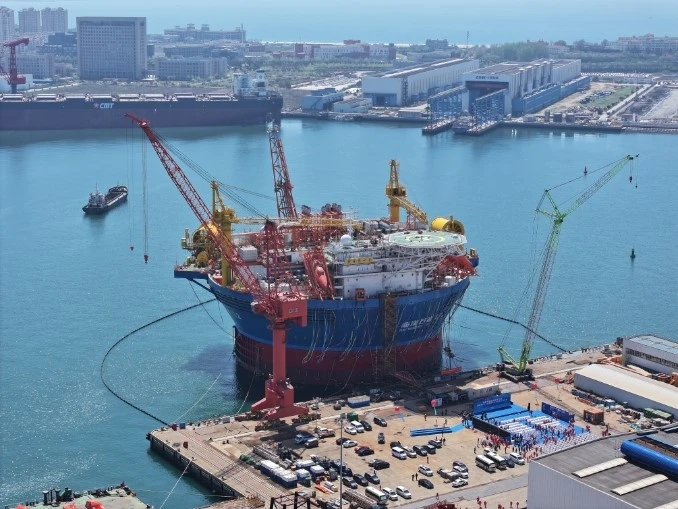
Photographed by Han Qing and Zhong Peiyun
It is nearly 30 stories tall and weighs as much as 30,000 cars.
According to reports, "Haikui No. 1" integrates crude oil production, storage, export and other functions. It is the world's first "digital data center" that integrates multiple systems such as an integrated marine monitoring system, a data integration platform, and a mechanical equipment health management system. The "intelligent" cylindrical floating production, storage and offloading unit (FPSO) consists of two parts: the hull and the upper functional module. It is composed of nearly 600,000 parts and components, with a maximum oil storage capacity of 60,000 tons. According to the severe sea conditions encountered once in a century, It is designed with a design life of 30 years and can operate continuously at sea for 15 years without returning to dock.
The main deck of "Hai Kui No. 1" has a maximum diameter of 90 meters, an area equivalent to 13 standard basketball courts, a height of nearly 30 stories, and a total weight equivalent to 30,000 cars.
The construction cycle is nearly 50% shorter than that of similar international equipment, and the first-time quality pass rate exceeds 99.8%.
Due to the complex production process and high degree of integration of equipment and facilities, it poses great challenges to design and construction technology.
"Compared with conventional ship-type structures, cylindrical FPSOs are smaller, more compact, and have higher oil storage efficiency. They also have the advantages of less steel consumption, good stability, and strong ability to withstand harsh sea conditions, which can effectively reduce oilfield costs. Development and operating costs," said Liu Huaxiang, general manager of the Deepwater Engineering Construction Center of CNOOC Shenzhen Branch.
"The project team concentrated its superior resources to overcome a series of technical problems such as integrated system design, high-precision construction integration, and full-process digital debugging of cylindrical floating production equipment. The construction period was nearly 50% shorter than that of similar international equipment, and the precision control reached Millimeter level, the first-time quality pass rate exceeds 99.8%, and excellent safety performance of 8 million working hours without accidents has been achieved. The overall project construction has reached the world's advanced level, giving our country the ability to independently build different types of deepwater oil and gas equipment according to different oil fields and different sea areas. capabilities." said Zhang Meng, deputy general manager of COOEC Project Branch.
4 steps to complete "Big Boat Back Small Boat"
"Hai Kui No. 1" is heavy, and its draft is close to the channel limit. It can only leave the port during astronomical tides. The sea state window that meets the operating conditions is only 3 days per month.
Since "Hai Kui No. 1" itself has no power and cannot self-propelled at sea, in order to shorten the voyage and reduce transportation risks, it needs to be loaded onto a semi-submersible transport ship like cargo and transported to Tieback installation is carried out in the Pearl River Mouth Basin.
The cylindrical structure of "Hai Kui No. 1" causes it to have a large wind surface and is easily prone to rotation. Therefore, loading is the most technically difficult and risky link in the transportation process of "Hai Kui No. 1".
The shipping process is mainly divided into 4 steps.
First, four tugboats towed the "Hai Kui No. 1" to the open sea. At the same time, the stability and posture during the towing process were ensured by adding water ballast to the cabin.
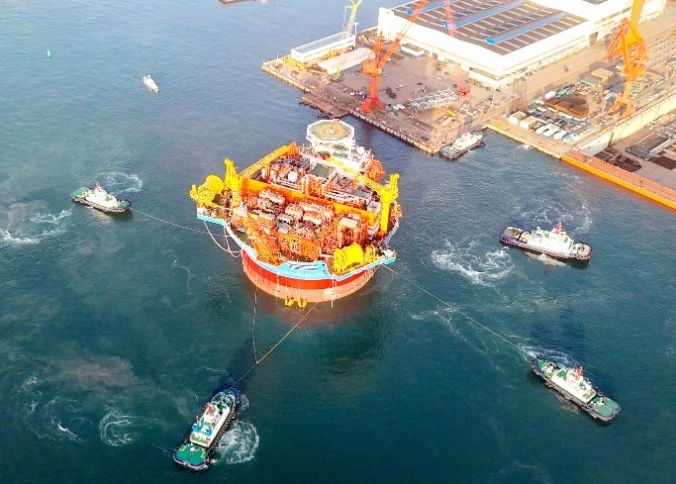
The tugboat towed the "Hai Anemone No. 1" to the open sea. Photo by Zhang Jinggang
In the second step, the transport ship "stands firm" by anchoring, and adds water ballast to the cabin to dive to the designed depth to ensure that it will not collide with the "Hai Kui No. 1" during the loading process.
The third step is for the working boat to pull the "Hai Kui No. 1" to the designed position of the transport ship through the precise positioning system in cooperation with the tugboat. "The 'Hai Kui No. 1' is towed to the designed position of the transport ship by 'threading needles and threads' on the turbulent sea. The positioning accuracy is required to reach millimeter level, and no collision is allowed during the process. The technical difficulty is the highest among similar ship-loading operations in the industry." "The most." said Wang Jiqiang, CNOOC Offshore Oil Engineering's "Haikui No. 1" installation project manager.

"Hai Kuan No. 1" was successfully shipped. Photo by Zhang Jinggang
In the final step, the transport ship discharges the ballast water and floats on it, then picks up the "Hai Kui No. 1" on its back to complete the loading operation.

After the transport ship deck is fully surfaced, follow-up operations such as loading and fixing will be carried out to ensure the safety and stability of "Hai Kui No. 1" during maritime transportation.
The shipment of "Haikui No. 1" successfully applied underwater precise positioning technology for the first time in the domestic offshore platform shipment, and the positioning accuracy reached the world's advanced level. The technical solutions, calculation analysis, operation control, etc. involved in this shipment were all provided by our country. Completed independently, it pioneered the independent implementation of the entire process of loading and unloading of ultra-large cylindrical floating production equipment in my country.
Innovatively forming the first "deepwater jacket platform + cylindrical FPSO" development model in China
After the "Haikui No. 1" is shipped, it will be shipped to the Liuhua Oilfield in the Pearl River Mouth Basin for tie-back installation in the near future. The sailing distance is more than 1,200 nautical miles. After the installation is completed, it will float on the sea with a water depth of 324 meters and can handle about 5,600 oils per day. tons of crude oil, together with Asia's first deepwater jacket platform "Haiji No. 2", it serves in my country's first deepwater oil field - Liuhua 11-1 Oilfield, innovatively forming the first domestic "deepwater jacket platform + cylindrical FPSO" development model, providing a new solution for the efficient development of my country's deepwater oil and gas fields.
Independent research and development of new equipment drives coordinated development of the domestic industrial chain
"Haikui No. 1" is highly integrated with more than 700 key equipment, about 90% of which are independently designed and manufactured by my country.
Liu Huaxiang introduced that "Haikui No. 1" has realized the independent application of 15 key technologies and equipment such as sea and land integrated intelligent central control system, natural gas twin-tower process desulfurization system, and large-capacity hydraulic submersible pump, and has adopted new natural gas for the first time on a domestic offshore platform. Desulfurization devices and dual-fuel generators can make full use of oilfield associated gas and effectively improve the green energy-saving level of offshore oilfields.
Liu Huaxiang said that we have carried out targeted research on more than 10 sets of domestically produced equipment such as large-size anchor chains, cargo oil pumps, monitoring and control equipment, and process equipment, which have made up for the shortcomings of the domestic offshore engineering industry and driven the development of new materials including steel and high-end new materials. High-quality development of R&D, major equipment and high-end equipment manufacturing industries.
The fully independent design and construction of "Haikui No. 1" plays a leading role in the entire industry chain. At present, our country has fully developed the independent research and development capabilities for offshore oil and gas engineering equipment within a water depth of 3,000 meters, and its independent design and manufacturing level of offshore deepwater oil and gas equipment is gradually entering the world's first camp.