


The Deepest Well in Asia Was Successfully Opened! What Black Technologies Are Used From Finding Oil To Extracting Oil
Nov 18, 2023
Natural gas buried 9,432 meters underground spewed out, and the burning flames witnessed a new historical moment. my country's key oil and gas project "Deep Earth Engineering" located in the Tarim Basin in Xinjiang, Sinopec's "Shendi No. 1" Yuejin 3-3 well was successfully opened after 177 days of drilling operations.
After 177 days of drilling operations, Sinopec's "Shendi No. 1" leapt into Well 3-3 and successfully obtained high-yield oil and gas flow from 9,432 meters underground. This depth also broke the current record for the deepest well in Asia. According to calculations, the daily output of this well will reach 200 tons of crude oil and 50,000 cubic meters of natural gas after it is put into production.

Cao Zicheng, deputy general manager of Sinopec Northwest Oilfield: The successful test of this well further proves that the Tarim Basin is rich in ultra-deep oil and gas resources. We have also explored and formed a set of exploration, development and engineering technology systems for complex ultra-deep oil and gas reservoirs, and deep earth engineering has made phased progress.

Marching into the deep underground to ensure national energy security, my country has made a series of breakthroughs in the exploration and development of deep oil and gas resources in recent years. Up to now, a total of 352 oil and gas fields have been discovered in my country below 4,500 meters. At present, the exploration and development of the Tarim Basin has fully entered the ultra-deep layer, and the largest ultra-deep oil and gas production base in my country has been built.
Why we need to overcome difficulties
Go nearly 10,000 meters underground to look for oil and gas?
What is the concept of oil extraction at a location 9,432 meters underground? "9432 meters" is the depth of the deepest well onshore in Asia in the field of oil and gas exploration. If it's on the ground, it can be reached by normal walking in two hours; if it's vertically upward, it's 9,432 meters, which is nearly 600 meters higher than the world's highest peak, Mount Everest; if it's on the bottom of the sea, it's 9,432 meters, which can basically penetrate most ocean areas. . The Mariana Trench, the deepest part of the ocean floor, has a depth of about 11,000 meters. Why do we need to search for oil 10,000 meters deep underground? How difficult is it to extract oil from the depths of the Tarim Basin? How can we discover oil and gas resources deep in the earth? If we find ultra-deep oil and gas, how can we extract it?
Marching into the deep earth is a strategic scientific and technological issue that our country must solve. my country's oil and gas resources are mainly distributed in seven major basins including Tarim, Ordos, Songliao, Bohai Bay, Sichuan, Junggar and Qaidam. However, the situation in the Middle East is different. More than one-third of my country's oil and gas resources are known to be distributed 4,500 meters underground, and some are even deeper. The oil and gas resources reach 67.1 billion tons of oil equivalent. Deep and ultra-deep layers have become our country's The main site for major oil and gas discoveries. Currently, 60% of the world's new oil and gas reserves come from deep onshore strata.

Cao Zicheng, deputy general manager of Sinopec Northwest Oilfield: Our country's oil and gas exploration in shallow and medium layers has entered a highly mature stage, but deep-seated resources are very abundant. The Tarim Basin is one of the basins with the greatest potential for increasing onshore oil and gas reserves and production in our country. Deep and ultra-deep oil and natural gas resources account for 83.2% and 63.9% of the total, respectively. Exploration, development and utilization of deep oil and gas resources can better ensure national energy security and secure the energy job.
From the depths of the Tarim Basin
How difficult is it to "get oil"?
During the Cambrian period 500 million years ago, the Tarim Basin was also called the "Tarim Sea". Hundreds of millions of years of vicissitudes have buried the carbonate formations deposited in the ocean thousands of meters underground, slowly forming oil and natural gas. The geological conditions of the Tarim Basin are completely different from other basins in the world. So how difficult is it to extract oil from the depths of the Tarim Basin?
Liu Xianghua, manager of Sinopec Northwest Oilfield Engineering and Technology Management Department: When drilling a well in the Tarim Basin, after drilling reaches a certain depth, the difficulty will increase exponentially every time it goes down one meter. Different from surface construction, there are many difficulties in the deep zone. In deep oil exploration and development in the Tarim Basin, when drilling reaches 9 kilometers underground, the temperature at the bottom of the well is about 200°C and the formation pressure is more than 150 MPa. It is the most difficult measure of drilling in the world. Among the 13 indicators, 7 of the Tarim Basin ranked first.
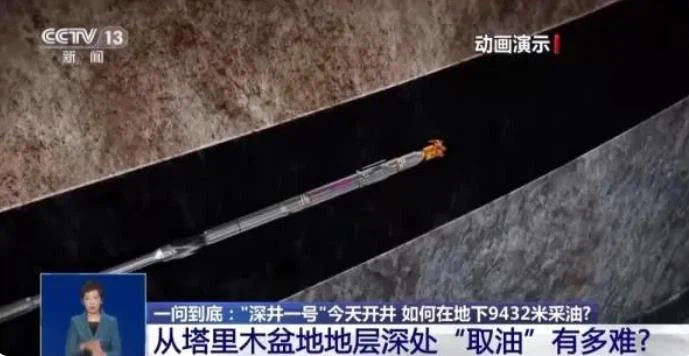
To extract oil and gas from underground at a depth of 9 kilometers, nearly a thousand drill pipes need to be connected. These drill pipes are like cooked noodles and are difficult to operate and control. At the same time, in the face of high temperatures of about 200°C, electronic components and rubber parts in general equipment and instruments will be damaged and fail. The navigation system on the drill bit will also fail, making it difficult to accurately reach the target location.

Liu Lian, President of Sinopec Northwest Oilfield Petroleum Engineering Technology Research Institute: Through extreme innovation and research, we have explored and formed a set of complex ultra-deep well structure design and supporting technologies, established a series of standards and specifications, and realized my country's key core technologies With this breakthrough, the drilling cycle has dropped from 280 days three years ago to the current lowest of 97 days, and the target accuracy has increased from 60% to more than 90%.
Oil and gas resources buried deep in the earth
How to be "seen"?
How can we know where the oil and gas resources are hidden underground? Geophysical prospecting is the first step in oil and gas exploration and development.
Geophysical prospecting is to perform high-definition CT scans of the earth. It requires designing a large network in the target area to create high-precision and controllable artificial seismic waves at different points to accurately detect the location and shape of underground oil and gas reservoirs. Without geophysical prospecting technology , it will be impossible to find oil and gas, and there will be no specific target for drilling.

The Shunbei Oil and Gas Field is located in the hinterland of the Taklimakan Desert. The seismic waves have to pass through the quilt-like thick sand layer twice from departure to return, with a propagation distance of more than 20,000 meters. The collected data are usually messy. After a large amount of experiments and simulation data, the scientific research team innovated weak signal recovery technology and restored ultra-deep seismic signals, making the ever-changing underground world gradually clear before our eyes.
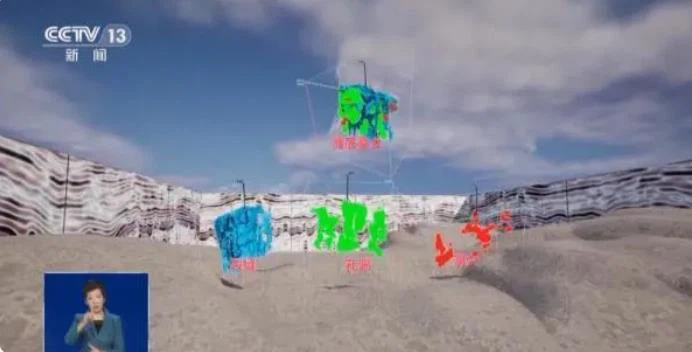
Another problem is that in the ultra-deep oil-filled "room", multiple volcanoes erupted magma, forming 500 to 700-meter-thick igneous rocks. When seismic waves pass through the igneous rocks, interference occurs, and after returning to the receiver, they form Complex information. The scientific research team established a data model of strata and fault zones, eliminated messy signals, and improved the accuracy of ultra-deep fault identification from 30 meters to 15 meters, thereby obtaining real images of the underground.

Han Jun, chief geologist of Sinopec Northwest Oilfield Exploration and Development Research Institute: Although the fault distance we identified at a depth of 9,000 meters is only 15 meters, this is because our scientific researchers have gathered outstanding scientific research teams at home and abroad through the "big corps" scientific and technological research model. After nearly four years of painstaking exploration, we have obtained relatively clear images of the 10,000-meter ultra-deep layer, which can guide us to more accurately find where oil and gas are stored.

In terms of geophysical prospecting, Sinopec has developed a series of key technologies for ultra-deep geophysical prospecting. It is equivalent to us having a more advanced earth-penetrating "telescope". This ground-penetrating "telescope" not only allows us to clearly see the once unfathomable "underground Mount Everest", but the images are also very "high-definition".

Cao Zicheng, deputy general manager of Sinopec Northwest Oilfield: The Shunbei Oil and Gas Field has discovered four 100-million-ton oil and gas areas, achieving a major breakthrough. "Deep Earth No. 1" has also become the source of original "Deep Earth" technologies in the oil and gas field.
From oil search to oil extraction
What black technologies can help?
"Shendi No. 1" jumped into Well 3-3. What black technologies were used from oil search to oil production? According to experts, this is inseparable from two major technologies. One is geophysical prospecting, which is equivalent to clairvoyance and ears, and the other is high-precision drilling technology like a greedy snake, which can "hit wherever you point."
First, we need to design a well trajectory road map and use geophysical prospecting technology to establish a digital parallel space of the formation. Through the positioning of the drilling tool, wherever the drill bit drills, the scientific research team will mark it in the "metaverse" of this stratum, which is equivalent to the navigation system of the drill bit in the data map to clearly see the obstacles in front. In the dark underground world, if the drill bit deviates from its position, a "navigation system" is needed to re-plan the trajectory to help the drill bit drill to the oil and gas reservoir.
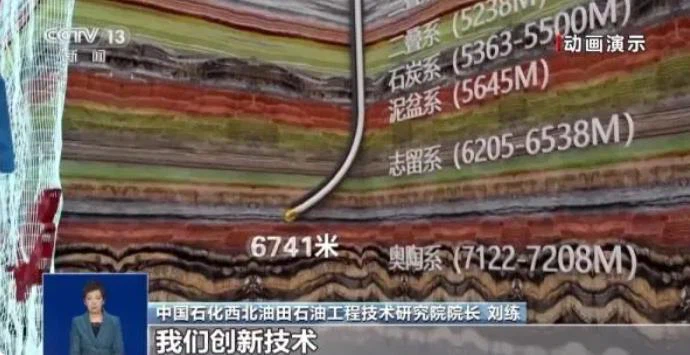
Liu Lian, President of Sinopec Northwest Oilfield Petroleum Engineering Technology Research Institute: The drill bit has to pass through multiple formations during the drilling process, and the pore development, oil and gas enrichment status, and rock properties of each formation are very different. We innovate technology and adopt corresponding technologies and methods in each formation. For example, the Permian system has many tiny fractures. Under high pressure, the drilling fluid that protects the drill bit is easily lost, and the well wall will collapse. By adding bamboo fiber to the drilling fluid, we quickly formed a protective film on the drilling wall and tamed the Permian formation.

Scientific researchers used high-temperature quartz, titanium alloy and other aerospace high-temperature-resistant materials to successfully develop the country's first set of high-precision measurement-while-drilling instruments with a temperature resistance of 200°C and a pressure resistance of 207 MPa, achieving "point and drill" at a depth of nearly 10,000 meters underground. ”, the geological target accuracy hit rate reached 100%.
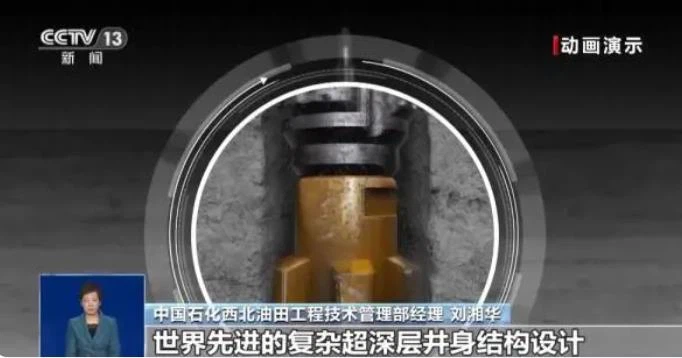
Liu Xianghua, Manager of Sinopec Northwest Oilfield Engineering and Technology Management Department: Through innovative research, we have explored and formed a set of world-leading complex ultra-deep well structure designs, supporting technologies and standard specifications, achieving a breakthrough in key core technologies for my country's oil and gas development. Drilling The cycle time has dropped from 280 days three years ago to 97 days, and the accuracy has increased from 60% to 90%.


